
Criminal Court Records in Newton County
A criminal court record is the case file the court clerk opens once the state files charges. In Newton County, the Circuit Clerk keeps the file for felony cases tried in Circuit Court. The clerk receives the lawsuits, indictments, motions, and other papers in each case. The office then keeps a general court docket. That docket lists the names and parties, the pleas, the indictments, and any lower-court records on appeal. Court orders go into the minute book. The clerk also enters a full record of the proceedings. So the file is far more than one charge. It is the whole life of the case from start to close.
Three court levels handle criminal matters in Newton County. The Circuit Court hears felony cases and sits in the 8th Circuit District. Judges Mark Duncan and Caleb E. May serve that district. A grand jury returns the felony indictments that start most of these cases. The Justice Court handles misdemeanor cases, county traffic offenses, bond hearings, and preliminary felony hearings. It can also issue search warrants. The Newton Municipal Court hears city misdemeanors, ordinance breaks, and traffic inside city limits. Each court keeps its own file. The charges themselves get a closer look on the Newton County court charge records page.
How to Search Newton County Criminal Records
Mississippi runs Newton County court records through Mississippi Electronic Courts, known as MEC, and its public arm PAMEC. The system is the statewide route for many Circuit and Chancery case files. Public online use needs a registered account and an annual fee. When the portal is down or asks for more access than a user holds, the local clerk stays the surest path.
- Open the MEC public access portal and pick the court type.
- Search by the defendant name or by the case number.
- Narrow the results by court, case type, and filing date.
- Open the case to read the docket, the charges, and the disposition.
- Ask the Circuit Clerk for a certified copy when a sealed-stamp copy is needed.
Registration on MEC asks the user to choose a user type and pay the yearly fee. Both attorney and non-attorney accounts cost the same set amount. If the public search page errors out, the MEC help desk can assist by phone or email. For older or paper Newton County files, the Circuit Clerk is the real custodian. A Newton County criminal records search at the clerk's counter carries a $10 fee. Staff research runs $20 per hour with a one-hour minimum. The full set of files is mapped on the Newton County court records page.
Note: MEC public access can return a system error, so keep the Newton County Circuit Clerk phone line ready as a backup when the portal will not load.
Stages of a Newton County Criminal Case
A Newton County criminal case moves through set stages. Each stage leaves a mark in the court file. The first entry is the charge or the indictment. The last entry is the sentence or the dismissal. Reading the docket in order shows how the case went from open to closed.
Case flow: Charges Filed › Arraignment › Pretrial / Motions › Plea or Trial › Disposition › Sentencing
| Stage | What Happens |
|---|---|
| Arraignment | The defendant hears the charges in open court and enters a plea. The judge may also set or review bond at this point. |
| Pretrial / Motions | Lawyers file motions, share evidence, and argue legal points. Many cases settle or plead out during this phase. |
| Plea or Trial | The defendant pleads guilty, or a jury or judge weighs the proof. At trial the State must prove a charge beyond a reasonable doubt. |
| Sentencing | After a guilty plea or verdict, the judge sets the penalty. The order can include jail or prison, probation, fines, and restitution. |
Newton County felony cases reach these stages in Circuit Court. Misdemeanor cases run a shorter path through Justice or Municipal Court. The grand jury step applies only to felonies. A first appearance and a preliminary hearing often happen in Justice Court before a felony case is indicted.
What a Newton County Criminal Record Shows
A Newton County criminal case file is built field by field. Each field answers a basic question about the case. The clerk's docket ties them together in one place. These core fields appear in most Newton County criminal records.
| Field | What It Shows |
|---|---|
| Case Number | The unique ID the clerk assigns to the case. It is the fastest way to pull the file. |
| Defendant | The person charged. Criminal cases read as State of Mississippi versus the defendant. |
| Charges | Each offense filed, often with a code and a degree such as felony or misdemeanor. |
| Plea | The defendant's formal answer, such as guilty, not guilty, or no contest. |
| Disposition | The final result, such as a conviction, a dismissal, or an acquittal. |
| Sentence | The penalty after a conviction, including jail time, probation, fines, or restitution. |
Other fields ride along in the Newton County file. It names the court, the filing date, and the judge. It logs each motion, order, and continuance. It tracks bond, court costs, and any restitution owed. Some private data stays out of public view. Social Security numbers, full birth dates, and minor details are redacted or sealed under court rules.
Charges vs. Convictions
A charge is not a conviction. The two sit at very different points in a case. A charge is only an accusation that the state must still prove. A conviction is a finding of guilt after a plea or a trial. A Newton County criminal record can show charges that were later dropped, dismissed, or beaten at trial. Reading the disposition in the Newton County file tells you which one applies.
| Charge | Conviction | |
|---|---|---|
| Stage | Accusation | Verdict or plea |
| Burden of Proof | Probable cause | Beyond reasonable doubt |
| Public Record | Yes | Yes |
Newton County arrest blotters list charges, not outcomes. Those reports note that suspects stay innocent until a court finds otherwise. The court file is the place to confirm whether a charge ended in a conviction.
Note: A dropped or dismissed charge still appears in the Newton County case file, so always read the disposition before assuming any final outcome.
Reading Newton County Dispositions and Sentences
The disposition is the bottom line of a Newton County criminal case. It tells you how the matter ended. A guilty plea, a guilty verdict, a not-guilty verdict, and a dismissal are all dispositions. A nolo or no-contest plea means the defendant did not fight the charge but did not admit guilt. A deferred or non-adjudicated result can hold off a conviction while the defendant meets set terms.
The sentence sits next to the disposition in the file. A Newton County sentence can mix several parts. It may set a prison term with MDOC, then suspend part of it. It can add probation, fines, court costs, and restitution to a victim. News reports of local Circuit Court pleas have shown suspended time, probation, and program orders in the same case. The exact terms live in the sentencing order signed by the judge.
The Mississippi Judiciary reported on an Eighth Circuit Drug Court graduation that sent 19 people through the program in 2017.
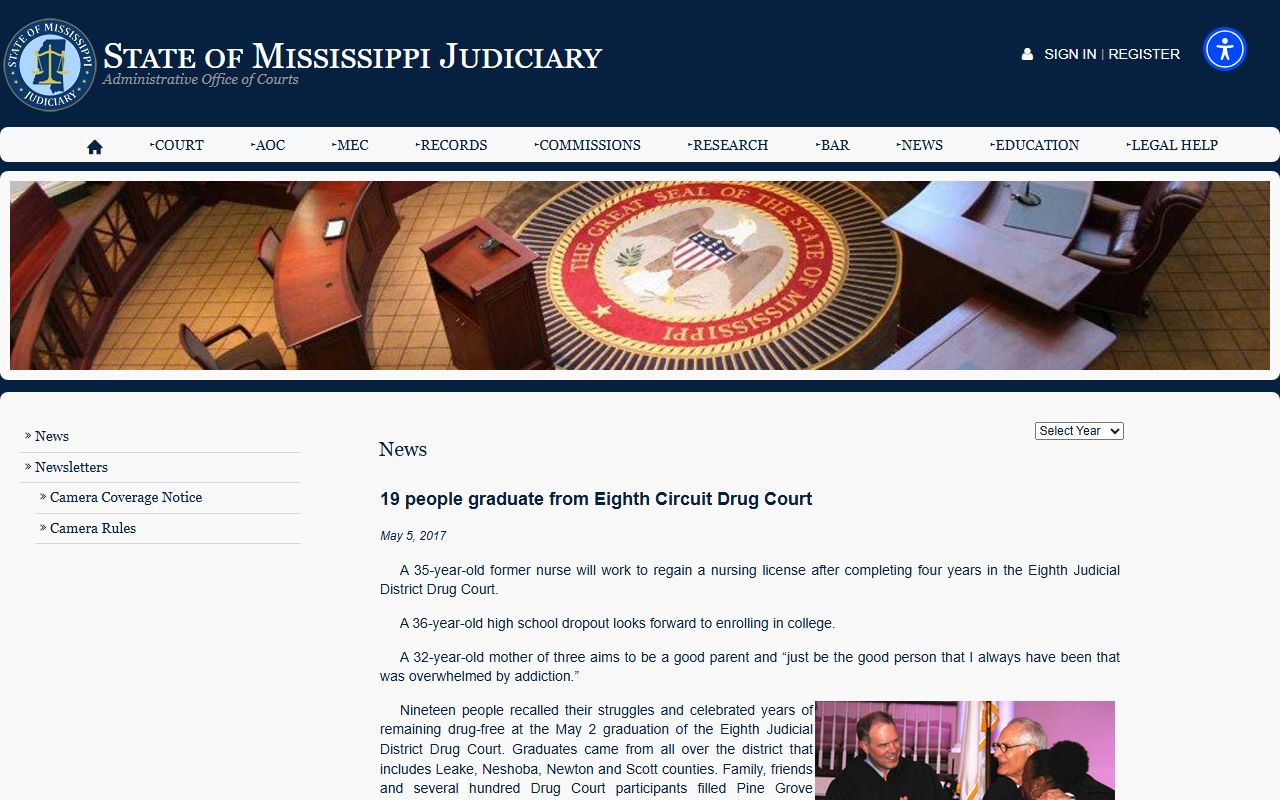
Completing a program like that can change the sentence noted in the Newton County file, turning suspended time into a closed case.
Who Files Newton County Criminal Charges
Two prosecutors handle criminal matters tied to Newton County. The District Attorney for the 8th District leads felony cases in Circuit Court. That office takes matters to the grand jury and tries the indicted cases. The County Prosecuting Attorney handles misdemeanor youth court work and lower-court matters. He also represents the state when justice or county court cases are appealed to Circuit Court.
District Attorney, 8th District
Steven Kilgore
P.O. Box 603, Philadelphia, MS 39350
601-656-1991
County Prosecuting Attorney
J. Douglas Smith
92 West Broad Street, Decatur, MS 39327
601-635-2367
A Newton County charge can start with a citation or an arrest. From there it may move through a city court, the Justice Court, the County Prosecuting Attorney, or the District Attorney. The charge level and the court decide the path. Felony indictments connect to the District Attorney and the Circuit Court.
Newton County Intervention Court Records
Some Newton County defendants enter an intervention court. Mississippi uses that name for what many states call drug court. The program gives non-violent, drug-linked offenders close supervision instead of a long jail term. It aims to treat addiction while still holding people to account.
The state courts site explains how Mississippi intervention courts handle drug-using offenders through full supervision.
That supervision shows up in the Newton County criminal case file as orders, referrals, and status notes. The county sits in the 8th Circuit District with Leake, Neshoba, and Scott counties. The Eighth Judicial District Drug Court serves all four. It is tied to Circuit Court, not a separate search site.
The judiciary also lays out the intervention court movement and its purpose, which is to cut repeat crime linked to addiction.
A case file may log a referral, a sanction, a program status, a graduation, or a termination. Records of a person's progress appear in the case docket, not in a public program portal.
A later Eighth Circuit Drug Court graduation update noted about 15 expected graduates that year.
When a person graduates, the court file can show a modified sentence or a closed case. Eligibility is never promised. It turns on the charge, the history, and the court's approval.
Note: The intervention court is a supervision program, so its progress appears inside the Circuit Court case docket rather than in any separate public database.
Sealed vs. Expunged Records
Some Newton County criminal records leave public view. A judge can seal a case so the public docket shows little or nothing. An expungement goes further and clears the record under the law. The two are not the same, and each follows its own rules.
| Sealed | Expunged | |
|---|---|---|
| Visibility | Hidden from public | Destroyed / treated as never existed |
| Law Enforcement | Limited access | Very limited |
| Eligibility | By court order in set cases | Misdemeanor or felony per § 99-19-71 |
Newton County handles a criminal records expungement through a petition filed with the court of record. The Circuit Clerk fee page lists a $150 petition fee once all court costs and fines are paid. These steps outline the general path under Miss. Code Ann. § 99-19-71.
- Find the court where the charge or conviction sits, such as Justice, Municipal, or Circuit Court.
- Pull the case number and the disposition from the file.
- Confirm that all fines, costs, and restitution are paid in full.
- Check eligibility under the statute or the rule for the type of dismissal.
- File the petition with the clerk and pay the $150 fee.
- Serve the granted order on the agencies that hold the record.
Eligibility is fact-specific. Felony, DUI, domestic, sex, and violent cases follow stricter rules. A lawyer or a direct call to the court is the safer route for those histories.
Note: An expungement order must reach every agency that holds the record, or the old entry can still surface in a later background search.
Public Access to Newton County Criminal Records
Newton County criminal case files are public records by default. The Mississippi Public Records Act backs the right to inspect and copy them. The right still has limits. Sealed files, youth court records, and expunged cases stay closed. Redaction also keeps private identifiers out of public copies. When a case is in a participating court, MEC offers online access, while the clerk's office covers older and paper Newton County files.
Key Statutes:
Mississippi Code § 25-61-1 - Public records are open for inspection unless a law or exemption says otherwise.
Mississippi Code § 43-21-261 - Youth court records are not ordinary public records and open only as the law allows.
Background Check Considerations
A casual Newton County record lookup is not a formal background check. A name search on a court portal can miss cases, mix up people, or lag behind the court. A formal background check follows the Fair Credit Reporting Act and uses a regulated agency. Employers, landlords, and lenders must use an FCRA-compliant source. A court file read for personal interest does not meet that standard.
Important: This site is not a consumer reporting agency under the FCRA, and its records cannot be used for hiring, housing, credit, or other FCRA-regulated decisions.
Restricted Criminal Court Records in Newton County
Not every Newton County criminal record is open. Youth court files are confidential by law. They open only to the child, the parents, attorneys, court staff, schools, law enforcement, or others a statute names. Sealed Newton County cases stay closed until a judge says otherwise. Expunged records are removed from public access under the order that cleared them.
Active Newton County cases can also be limited while they move forward. Some filings hold medical, financial, or minor details that the clerk must protect. Adoption and commitment files are not ordinary searchable records. When a file is sealed or unclear, a direct call to the clerk is the right next step. The Circuit Clerk can confirm whether a record is open, archived, or closed.