
What Newton County Probate Records Cover
Probate is a Chancery Court function in Mississippi. There is no separate probate court here. Newton County probate records are Chancery Court files. They cover wills and the estates of people who have died. They also cover guardianships, conservatorships, and commitment hearings. The same court handles related equity matters. That list includes minor settlements, heirship questions, and the sale of estate land. A Newton County probate case opens when an interested person asks the court to act. From that point, the Newton County file grows as the estate moves toward closing.
The Newton County courts page confirms that Chancery Court hears wills, estates, guardianships, conservatorships, and commitment hearings. In Newton County, the Chancery Clerk is the custodian of these records. That office is the place to call. Ask for an estate file, a guardianship record, or an old will. Newton County runs a split clerk system. The Circuit Clerk keeps felony and circuit civil records. The Chancery Clerk keeps probate, estate, guardianship, and divorce records. So probate searches start with the Newton County Chancery Clerk, not the Circuit Clerk.
Newton County Probate Terms Defined
Probate filings use words that come up again and again. A few short definitions help when you read a Newton County estate file. The terms below appear in Newton County petitions, orders, and letters issued by the court. Each one points to a role or a status in the case.
- Testator
- The person who made the will. When that person dies, the will is offered to the court for probate.
- Executor
- The person named in the will to carry it out. The court issues letters that confirm this authority.
- Intestate
- Dying without a will. State law then sets who inherits, and the court may name an administrator.
- Guardianship
- A court arrangement that lets one person care for a minor or for an adult who cannot manage personal needs.
- Conservatorship
- A court arrangement that puts one person in charge of another person's money and property.
How to Search Newton County Probate Records
There are several ways to find a Newton County probate record. The online route is Mississippi Electronic Courts, often called MEC or PAMEC. It is the statewide system for many Chancery and Circuit case files. Public online use needs an account and a yearly fee. The system can also be down at times. When that happens, the local clerk channels still work. Older estate files are best requested straight from the Chancery Clerk. The same goes for paper-only records. Many Newton County probate records are not viewable from a phone or a home computer.
In person, mail, and phone all reach the Newton County Chancery Clerk. The office sits inside the courthouse and is open on weekdays. A written request can travel by mail. It goes to the clerk's post office box. The Mississippi Public Records Act backs requests to inspect and copy public files. It does not unlock sealed estates. Nor does it open confidential guardianship details.
- Decide what you need. A will, a full estate file, or a guardianship record each lives in Chancery Court under the Chancery Clerk.
- Try MEC or PAMEC first if the case is recent and you want electronic access. Register and pay the annual fee, then search the participating Chancery records.
- Call or visit the Newton County Chancery Clerk when the file is old, sealed, archived, or missing from the online system, and ask whether a case number is needed.
- Order copies once the file is located. Ask the clerk for current copy and certification charges before you pay.
Note: If the MEC public search page will not load, contact the MEC Helpdesk or the Newton County Chancery Clerk rather than assuming the probate record does not exist.
Newton County Probate Court Contact
Probate in Newton County runs through Chancery Court. The county is part of the 2nd Chancery Court District. Hon. Robert M. Logan, Jr. serves as the Chancery judge. The judge hears the cases. The Chancery Clerk keeps and releases the files. Chrissie Buffington is the current Chancery Clerk. Deputy clerks Suzanne Gressett and Kimberly Harris also work the office. For a Newton County probate search, this is the office to contact first.
Newton County Chancery Clerk
92 W Broad St
P.O. Box 68
Decatur, MS 39327
601-635-2367 / 601-635-3370
Fax: 601-635-3479
Mon-Fri 8 a.m.-5 p.m.
Mail requests should go to the post office box. In-person searches and certified copies happen at the Broad Street counter. The clerk can confirm whether a file is open, archived, or sealed before you make the trip.
Newton County Probate Filing Fees
Newton County probate carries filing costs, copy costs, and certification costs. The county does not publish a separate probate fee list on the official Chancery Clerk page. So firm numbers should come straight from the source. Contact the Newton County Chancery Clerk for current probate filing and copy fees before you file or order copies. Fees from another county will not match, and probate charges differ from the Circuit Clerk schedule.
A few practical points help. Ask what an estate opening costs. Ask what certified copies run per page. Ask which payment methods the office takes. Confirm the total before a mail order ships. That keeps a request from bouncing back over a short payment.
What Newton County Probate Records Show
A Newton County probate file grows as the case moves along. It often starts with a petition and a will. Over time it gathers proof of death, heir details, and a list of estate property. Orders, notices, and a final accounting round out the file. Guardianship and conservatorship cases follow a like path, with petitions and court orders. The table below shows the parts of a typical Newton County estate file and what each part holds.
| Record part | What it shows |
|---|---|
| Petition or application | The request to open the estate and the person asking the court to act |
| Will and codicils | The signed will, if one exists, plus any later changes |
| Proof of death and heirship | Decedent details and the names of heirs or interested parties |
| Oath and letters | Letters testamentary or letters of administration that confirm the fiduciary's authority |
| Inventory and appraisement | A list of estate assets and their value |
| Creditor notices and claims | Notice to creditors and any claims filed against the estate |
| Orders, accounting, and discharge | Court orders, the final accounting, distribution, and the close of the estate |
Note: A bond may also appear in a Newton County probate file when the court requires the fiduciary to secure the estate before acting.
How Probate Works in Newton County
Probate follows a set order in Newton County. It begins when an interested person files in Chancery Court. If there is a will, the filer asks the court to admit it and name an executor. If there is no will, the filer may seek administration instead. The court can require notice to heirs and creditors. The fiduciary then handles assets, debts, and a final close. The steps below outline a routine Newton County estate.
- An interested person files a petition with the Newton County Chancery Clerk to open the estate.
- The court admits the will and appoints an executor, or appoints an administrator when there is no will.
- The fiduciary takes the oath and receives letters that grant authority to act for the estate.
- Notice goes to heirs and creditors, and the fiduciary files an inventory of estate property.
- Claims are paid, property may be sold under court order, and a final accounting is filed.
- The court approves the distribution and discharges the fiduciary, which closes the estate.
Routine estates can take months. Contested wills, missing heirs, creditor fights, or land in more than one state can take much longer. Guardianship and conservatorship cases run on their own track, since they protect a living person rather than settle an estate.
Note: A Newton County probate case can stay open for years when heirs are missing, a will is contested, or estate land must be sold.
Restricted Newton County Probate Records
Not every Newton County probate file is fully open. Some of these records hold sensitive content. Guardianship and conservatorship files often contain medical details. Many name a minor. Those parts can be shielded from public view. Commitment hearings, which Chancery Court also handles, can involve health records of the most private kind. A judge may seal an estate or a single document. The clerk cannot release sealed contents without court authority. Adoption files run through Chancery Court too, but they are not ordinary searchable family records.
Mississippi law is strict about records that involve children. The youth court confidentiality rules show how far that protection reaches.
The state's youth court records confidentiality statute keeps records that involve minors out of ordinary public release.
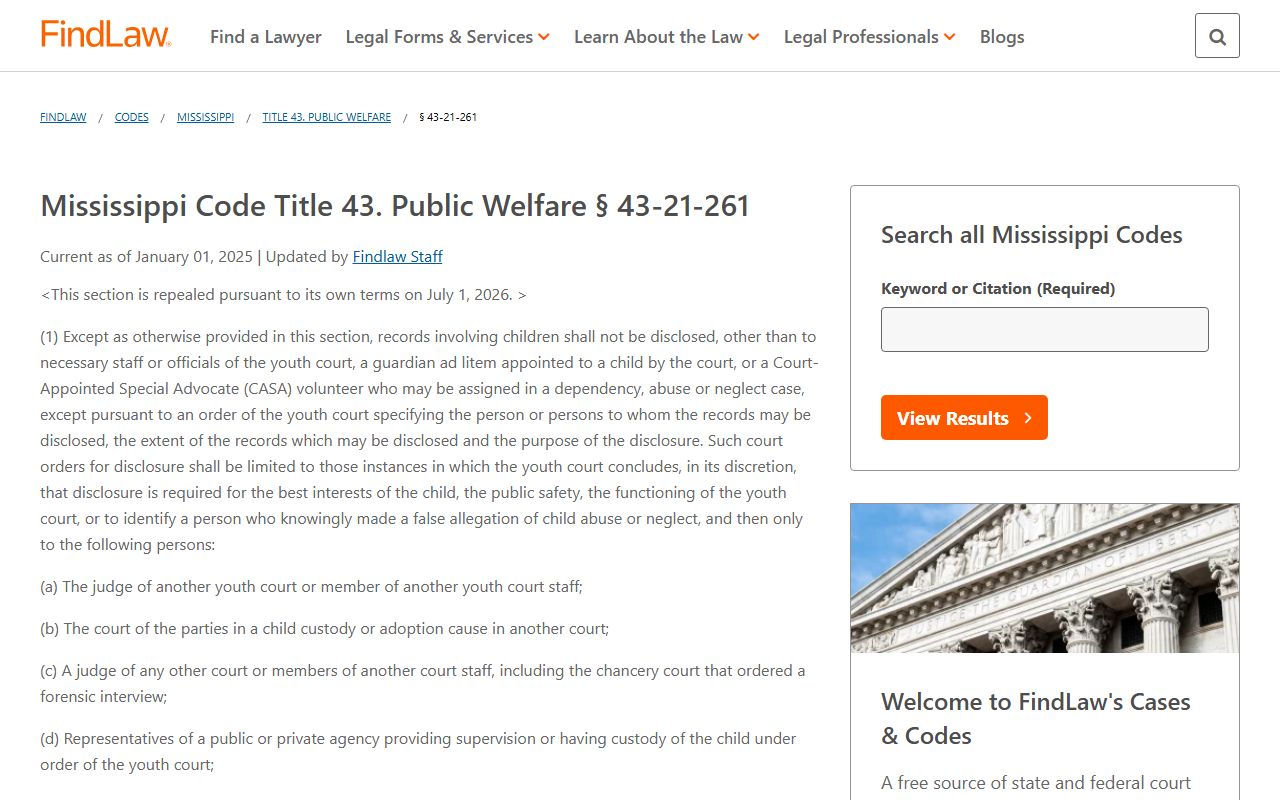
That same caution carries into Newton County guardianship and conservatorship files, where a child's details or an adult's medical status may be protected. Personal identifiers like Social Security numbers and financial account numbers are also redacted. When a file is sealed or confidential, the Chancery Clerk can only release what the law and the court allow. For divorce and custody files that often sit near probate matters, the Newton County marriage and divorce records page covers the same Chancery Court channels.